
 D2DCon
 Golden Door Summit
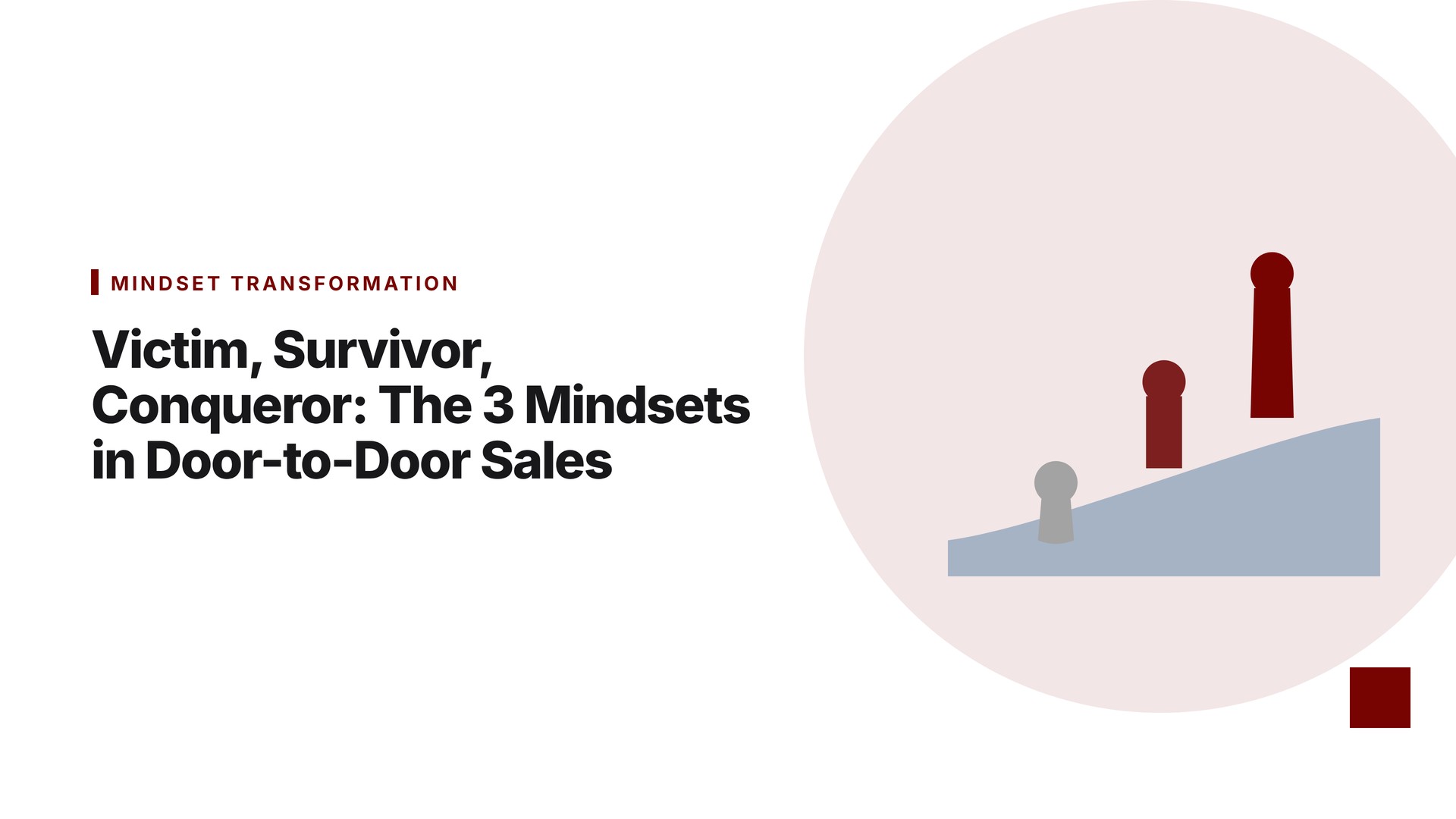
Victim, Survivor, Conqueror: The 3 Mindsets in Door-to-Door Sales
Sam Taggart here. Quick gut check for you.
It's 7:40 p.m. You've knocked all day, taken 30 nos, and your last "almost" just told you his cousin sells the same thing. Which of these sounds most like you on the drive home? "This area is garbage and the leads are worse." Or: "Rough one, but I survived, I'll grind again tomorrow." Or: "Interesting. Three of those nos hesitated at price. I'm changing my open tomorrow."
Same day. Three completely different reps. After 17 years on the doors and thousands of reps trained, I can tell you that answer predicts your income better than your territory, your product, or your pitch. There are three mindsets in this industry: the Victim, the Survivor, and the Conqueror. Every rep lives in one of them, and most don't know which. Let's fix that.
The Victim Mindset
The Victim believes his results happen TO him. The territory is bad. The leads are junk. The economy is off. The weather killed the day. Listen to a Victim talk for five minutes and you'll notice something: every explanation for his numbers lives outside of him.
You know the phrases. "This neighborhood is terrible." "Nobody's buying right now." "The company gave me a dead zone." And watch the behavior that follows, because mindset always leaks into behavior: skipping doors that "look like a no," starting late, quitting at 6 when the best hour is 7, half-hearted pitches delivered like apologies.
Here's the brutal part. The Victim's beliefs come true. Skip doors, knock fewer hours, pitch with low energy, and yes, the numbers will be awful, which proves the territory was bad all along. It's a self-sealing loop, and reps rot inside it for entire seasons.
Now the compassionate part, because this matters: the victim mindset isn't a character flaw. It's a protective mechanism. Blaming the turf hurts less than admitting your close needs work. Your brain is trying to shield your ego from rejection, and it's doing that job perfectly. It's just costing you a fortune to feel a little better. The Victim's real blind spot is simple: he cannot see the role he plays in his own results. And you can't change what you won't own.
The Survivor Mindset
The Survivor is the industry's biggest population, and the hardest to spot, because from the outside he looks fine. He shows up on time. He knocks his doors. He hits quota, most months. Managers don't worry about him. That's exactly the problem.
The Survivor isn't driven by hunger for what's possible. He's driven by fear of what happens if he stops. Fear of missing rent, fear of the awkward team meeting, fear of proving the doubters right. Fear is fuel, sure, but it's cheap fuel. It burns dirty and it never takes you past "enough."
You'll hear it in the language: "I just need to get through this month." "I'm doing okay." "Made quota, so, we're good." Notice nothing in those sentences reaches for anything. The Survivor hits the target and stops, every time, like there's a governor on his engine. One bad week derails his motivation. One good week justifies coasting.
Here's the insight that stings: comfort is the enemy of growth in this business, and the Survivor has negotiated a truce with comfort. He works hard enough to keep the discomfort away and never hard enough to find out what he's capable of. Victims quit the industry. Survivors haunt it, five years deep with year-one numbers, wondering why the new kid just passed them. Surviving is not thriving, dude. It just looks like it from a distance.
The Conqueror Mindset
The Conqueror runs on a completely different operating system: total ownership. Bad day? "What did I do or not do?" Bad month? "What system of mine failed?" Notice the pronoun. Everything starts with I, not with THEY.
To a Conqueror, rejection isn't pain, it's information. Thirty nos aren't thirty wounds, they're thirty data points begging to be analyzed. Which objection came up most? Where did doors go cold? What time did conversions spike? While the Victim licks wounds and the Survivor numbs out, the Conqueror is running diagnostics.
What do Conquerors actually do differently? They set goals that scare them, publicly. They dissect failures the way film junkies break down game tape. They build systems — morning routines, door quotas, nightly reviews — so their output doesn't depend on how motivated they feel. They're emotionally regulated at the door, disciplined off it, and they pull the whole team's standard up just by existing. Every top-1% rep I've ever coached lives here.
Two things you need to know, though. First, nobody is born a Conqueror. It's built through deliberate mental training, the same way a bench press is built. Second, being a Conqueror doesn't mean being invincible. Conquerors have brutal days like everyone else. They just recover in minutes instead of weeks. The skill isn't never falling. It's the speed of getting up.
How to Move Between Mindsets
Here's the roadmap, and it's simpler than you want it to be.
From Victim to Survivor, the move is ownership, taken in small bites. Don't try to own everything overnight, you'll snap back. Pick ONE area this week: "I own my door count." Next week: "I own my start time." Every time you catch a blame-sentence leaving your mouth, stop it and restate it with I. "The turf is dead" becomes "I haven't found the angle for this turf yet." Break the blame loop out loud, because your ears are listening to your mouth.
From Survivor to Conqueror, the move is hunger plus systems. Find a goal that genuinely scares you, a number you'd be embarrassed to say out loud, then say it out loud. Fear-fuel got you here; hunger-fuel gets you further. Then stop relying on motivation entirely: build a system, morning prep, activity quotas, nightly numbers review, that runs even on your worst day. Survivors have habits that maintain. Conquerors have systems that compound.
And a daily practice for everyone: one question before the first door. "Which mindset am I operating from today?" That ten-second check-in is worth more than an hour of pump-up music.
One more thing: environment. Mindsets are contagious. Sit in the truck with Victims and you'll catch it like a cold. Find the Conqueror-level reps in your company and physically be where they are. You become the average of the doors you knock AND the reps you ride with.
A Note for Sales Managers
Diagnosing your roster is straightforward if you listen. Victims blame in team chats. Survivors are quiet, steady, and allergic to stretch goals. Conquerors ask for harder targets and coach rookies without being told.
Coach each level differently. Victims need small ownership wins and zero lectures, assign one controllable metric and celebrate it hard. Survivors need a vision bigger than quota, ask them what they actually want their life to look like, then connect the doors to it. Conquerors need challenge and autonomy, give them a rookie to mentor and a record to chase — the same team-building instinct behind the Sales ManagerU certification.
And one warning from someone who's made this mistake: do not promote Survivors just because they're consistent. Leadership pressure crushes avoidance-based motivation. Promote hunger, not tenure.
Conclusion
Here's what I need you to hear: Victim, Survivor, Conqueror is a tool, not a verdict. Nobody lives in one box permanently. I've been all three, sometimes in the same week. The point isn't to shame yourself for visiting Victim after a brutal day. The point is to notice fast, and spend more and more of your hours at Conqueror.
Your mindset is the one piece of turf nobody can assign you, take from you, or knock for you. It's yours. Which means the results that flow from it are yours too, and so is the choice.
So, real question, no fluff: which mindset will you knock with tomorrow? Pick it on purpose. FULL SEND.