 D2DCon
 Golden Door Summit
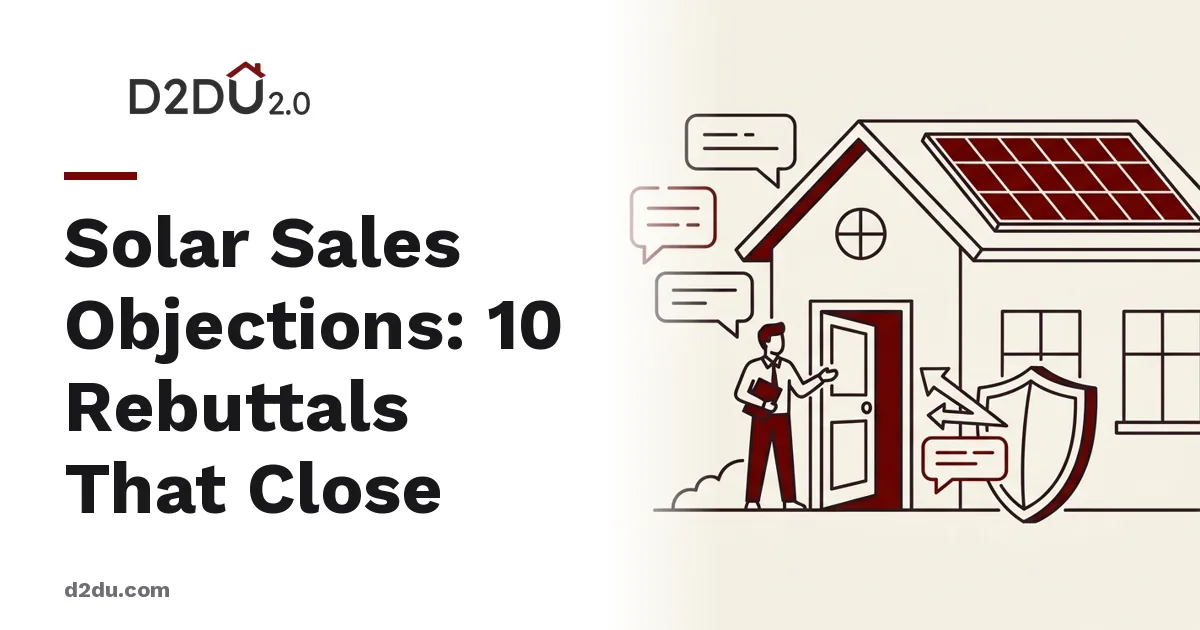
Solar Sales Objections: 10 Rebuttals That Close

- 10 rebuttals, 4 buckets: Price, stall, commitment and trust objections cover almost every no you hear at a solar door.
- Objections are questions: A no is usually a request for one more piece of information, not a rejection of solar.
- Delivery beats wording: Certainty and a calm tone close more than a clever script delivered nervously.
Most door-to-door solar reps lose the sale in the first ten seconds, not because the offer is weak but because they freeze on the first objection. The homeowner likes the idea of a lower bill, then hits back with cost, a spouse, a roof, or plain skepticism. The reps who earn the most are not the ones with the slickest pitch. They are the ones who expect each objection and have a calm, specific answer ready.
This guide groups the ten most common solar sales objections into four buckets, gives a word-for-word rebuttal for each, and ends with the delivery habits that make any rebuttal land. Treat every objection as a question the homeowner is asking, not a door being closed.
How to handle price objections in solar sales
Price objections are almost always about reallocation, not affordability, so the move is to show the homeowner they are already paying for power. Two of the most common versions are the flat "too expensive" and the "I need other quotes" stall.
"Solar is too expensive"
Most homeowners still picture a large cash check they cannot write. They are comparing solar to a luxury purchase instead of to the utility bill they already pay every month. Shift the frame from new spending to money they are already spending.
The rebuttal: "I get why that is the first thing that comes to mind, because solar used to work that way. The reality is you are already paying for power every month. We take that same money and put it toward a system you own, usually with nothing out of pocket to start."
"I need to get other quotes"
When a homeowner wants to shop around, they are telling you they do not yet trust that your number is fair. Do not fight it. Anchor your value and make yourself the person who helps them compare.
The rebuttal: "You should absolutely get other quotes on a decision this size, and I would tell my own family to do the same. Just know the cheapest bid usually means cheaper panels and worse service down the road. Leave me your other proposals and I will walk through them with you line by line."
How to handle the spouse and the not-interested stall
Stalls like the spouse and the instant "not interested" are rarely the real objection, so the job is to isolate what the homeowner actually thinks before you lose the conversation. Handle these by staying calm and asking one honest question.
"I need to talk to my spouse"
This is often a polite exit, not a scheduling fact. If you accept it at face value, you leave without knowing where the homeowner stands. Find that out first.
The rebuttal: "That makes complete sense, you two should decide together. So I know where you land, if your spouse came home excited about this, would you be all in, or would you still have a question or two of your own?"
"I am not interested"
The reflex "not interested" usually fires before the homeowner knows what you offer. You cannot argue with it because they are not declining solar, they are declining a sales pitch. Break the pattern and earn ten more seconds.
The rebuttal: "Totally fair, I did not expect you to be waiting for me today. The only reason I knocked is we just helped a neighbor cut their power bill, and I can show you in two minutes whether your home qualifies. Do you have your last power bill handy?"
How to handle commitment objections
Commitment objections come from fear of being locked in, so the fix is to shrink the risk and show a way out. The three you will hear most are moving soon, an old roof, and waiting for better technology.
"We are planning to move soon"
Homeowners worry a long agreement becomes a problem when they sell. Reframe the system as something the next buyer wants, and explain that the agreement moves with the home.
The rebuttal: "That is actually a reason to look now, not later. The agreement transfers to the next owner, and a lot of buyers like knowing the power rate is already locked in. It becomes one more thing that makes your home easy to sell."
"My roof is too old"
This one is often legitimate, and trying to install over a failing roof is a real mistake. Turn it into a bigger solution instead of a dead end.
The rebuttal: "Good catch, and we would never put panels on a roof that needs to come off. The good news is we can roll a new roof into the same financing, so you end up with a new roof and solar on one predictable payment."
"I want to wait for better technology"
Some homeowners treat solar like a phone that will be cheaper next year. Explain the cost of waiting instead of debating future panels.
The rebuttal: "The panels we install today are already efficient and reliable. If you wait a few years for a small bump in efficiency, you keep paying the utility the whole time. Every month you wait is money you do not get back."
How to handle product and trust objections
Product and trust objections are about belief, not logic, so you answer them with proof and transparency rather than pressure. The common three are looks, sunlight, and the fear that solar is a scam.
"Solar panels are ugly"
Homeowners picture the bulky silver panels from a decade ago. Agree with the old image, then show them what modern panels look like.
The rebuttal: "I am with you, the old panels were rough. What we install now is low-profile all-black, and it sits flush against the roof. Most neighbors think it looks like a clean upgrade, not a science project."
"We do not get enough sun here"
Many homeowners think solar only works in the desert. Correct the science without making them feel wrong.
The rebuttal: "Common misconception, and a fair one. Panels run on daylight, not just direct sun, so they still produce on cloudy days. We size the system around your actual local weather so it covers what you use through the year."
"I heard solar is a scam"
The industry has real bad actors, so this skepticism is earned. Do not get defensive. Separate yourself with proof.
The rebuttal: "I do not blame you, there are companies out there that earned that reputation. That is exactly why we keep everything transparent. I will show you local installs, real reviews, and every number behind your quote so nothing is a surprise."
How to deliver any solar rebuttal with certainty
The best rebuttal fails when it is delivered nervously, so your tone and pace matter as much as the words. Homeowners read confidence before they hear content, and a calm rep signals a trustworthy offer.
Slow down. Acknowledge the concern before you answer it, so the homeowner feels heard instead of handled. Then answer in one or two sentences and stop talking. Silence after a rebuttal does the closing for you. Never argue, because the moment it becomes a debate you have lost the trust that makes any of this work. Practice each rebuttal out loud until it sounds like you, not like a script you are reading off a card.
How to handle solar sales objections at the door
Use this sequence on any objection, not just the ten above.
- Pause and acknowledge the concern out loud before you respond.
- Ask one question to find out whether the objection is the real issue or a stall.
- Reframe the concern around money they already spend or risk they already carry.
- Deliver your rebuttal in one or two calm sentences, then stop talking.
- Confirm the concern is handled before you move toward the close.
- If it is a hard no, ask for a referral or a callback time instead of pushing.
Frequently Asked Questions
What is the hardest solar objection to overcome?
The hardest objection is the one the homeowner does not say out loud. A vague "I need to think about it" hides the real concern, whether that is money, trust, or a spouse. Your job is to ask a calm question that surfaces the true issue so you can answer the objection that actually matters.
How do you handle the "not interested" objection at the door?
Acknowledge it without arguing, then break the pattern with a reason to give you ten more seconds. A local name-drop works well, since a neighbor's result is more believable than a sales claim. Ask to see their recent power bill so the conversation shifts from a pitch to their actual numbers.
Should I argue with a homeowner who hates solar?
Never argue. Arguing creates tension and kills the trust a sale depends on. Validate the concern first, then calmly present facts and reframe the homeowner's view with logic. You win solar objections by lowering the temperature, not by proving the homeowner wrong in their own doorway.
How do I handle the "I need more quotes" objection?
Encourage it and make yourself useful. Tell the homeowner that comparing is smart, then anchor your value by pointing out that the cheapest bid usually means cheaper equipment and weaker service. Offer to review the competing proposals with them so you control the comparison instead of leaving it to chance.
What should I do if a homeowner says solar is a scam?
Agree that bad actors exist, because denying it makes you look like one. Then separate yourself with proof: local installations, verified reviews, and a line-by-line walk through the numbers. Skepticism drops fast when you are the rep who volunteers transparency instead of dodging it.
Conclusion
Solar sales objections are not walls, they are questions wearing a frown. Price objections ask about value, stalls ask for a reason to trust you, commitment objections ask about risk, and trust objections ask for proof. Group them that way and the ten scenarios above stop feeling random. Learn the rebuttals, practice them until they sound like you, and deliver each one slowly and with certainty. Do that and the homeowner stops hearing a pitch and starts hearing a person worth believing.


